CTI-CRYOGENICS 8112855 Board Cryopump Flange 200
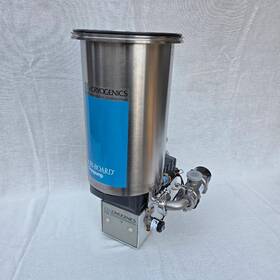
( Brand: Cti-cryogenics ), ( Manufacturer Part Number: 8112855 ), ( Type: Cryopump )
Review CTI CRYOGENICS On board Cryopump Iso k 200 Flange Needs Refurb
The **CTI Cryogenics 8112855 On-Board Cryopump with ISO-K 200 Flange** is a high-performance, ultra-high vacuum (UHV) solution engineered for demanding applications in scientific research, semiconductor manufacturing, and advanced materials processing. Designed for integration into compact, mobile, or space-constrained systems, this cryopump leverages cutting-edge cryogenic technology to deliver exceptional pumping speeds and reliability while maintaining minimal footprint requirements. The ISO-K 200 flange interface ensures seamless compatibility with standard vacuum chamber designs, facilitating easy installation and integration into existing or newly developed systems. Utilizing a closed-cycle helium refrigeration system, the cryopump achieves cryogenic temperatures through efficient thermal management, eliminating the need for liquid cryogens and reducing operational complexity. This design not only enhances safety by minimizing cryogenic hazards but also extends the system s operational lifespan through reduced maintenance demands. The 8112855 excels in pumping a wide range of gases, including hydrogen, helium, nitrogen, and water vapor, with pumping speeds that can reach up to several hundred liters per second, depending on the specific configuration and operating conditions. Its robust construction, featuring high-vacuum-compatible materials and precision-engineered components, ensures durability and long-term performance even under harsh or fluctuating environmental conditions. Ideal for applications such as thin-film deposition, surface science experiments, and particle accelerator systems, this cryopump offers a balance of efficiency, compactness, and versatility, making it a preferred choice for researchers and engineers seeking a dependable vacuum solution without compromising on performance.
### **Pros and Cons of buying a CTI-Cryogenics 8112855 On-Board Cryopump with ISO-K 200 Flange**
#### **Pros**
1. **High Vacuum Performance** Cryopumps excel at achieving ultra-high vacuum levels (UHV) by condensing and adsorbing gases, making them ideal for applications requiring extreme cleanliness, such as semiconductor manufacturing, particle physics, or surface science research.
2. **Low Operating Costs** Unlike mechanical pumps, cryopumps do not require continuous power consumption once the cryogenic cooling is established. They rely on liquid nitrogen or helium, which can be cost-effective in the long run, especially in high-duty-cycle applications.
3. **Compact and Space-Efficient Design** The on-board configuration integrates the cryopump directly into the system, reducing the need for additional piping and external components, which can simplify system layout and installation.
4. **Long Lifespan with Proper Maintenance** Cryopumps have no moving parts (except for the cryocooler in some models), reducing wear and tear. With regular cryogen refills and proper thermal cycling, they can last for years without major overhauls.
5. **Compatibility with ISO-K 200 Flange** The ISO-K 200 flange standard ensures compatibility with a wide range of vacuum chambers and systems, making integration easier without the need for custom adapters.
6. **Minimal Noise and Vibration** Unlike turbomolecular pumps, cryopumps operate silently and without vibration, which is beneficial for sensitive experiments or applications where noise is a concern.
7. **Versatile Applications** Suitable for a variety of industries, including:- **Semiconductor and microelectronics** (etching, deposition)
- **Particle accelerators and synchrotrons** (beamline chambers)
- **Surface science and materials research** (LEED, AES, STM)
- **Space simulation and testing** (thermal vacuum chambers)
8. **Reduced Backstreaming of Oils** Unlike oil-sealed pumps, cryopumps do not introduce contaminants into the vacuum system, which is critical for applications requiring ultra-clean environments.
9. **Scalability** The modular design allows for expansion or customization, such as adding multiple stages or integrating with other vacuum components.
10. **Energy Efficiency in Some Cases** While initial cooling requires energy, once stabilized, cryopumps consume minimal power compared to continuous mechanical pumping solutions.
---
#### **Cons**
1. **High Initial Cost** Cryopumps are generally more expensive upfront than mechanical pumps (e.g., turbomolecular or rotary pumps), which may be a barrier for small labs or startups with limited budgets.
2. **Dependence on Cryogenic Cooling** The pump requires a continuous or frequent supply of liquid nitrogen (LN ) or liquid helium (LHe), depending on the model. This adds operational complexity and cost, especially in remote or off-grid locations.
3. **Limited Pumping Speed for Certain Gases** Cryopumps are highly effective for most gases but may have reduced efficiency for noble gases (e.g., helium, neon) unless specifically designed for such applications. Some models require additional pumping stages for optimal performance.
4. **Thermal Management Challenges** Frequent thermal cycling (warming and cooling) can degrade the pump s performance over time. Improper handling or rapid temperature changes may lead to condensation of water vapor inside the pump, reducing its effectiveness.
5. **Maintenance and Cryogen Replenishment** Unlike mechanical pumps, cryopumps require regular refills of cryogens, which can be time-consuming and may require specialized handling (e.g., LN storage tanks). Neglecting this can lead to pump failure or reduced vacuum quality.
6. **Not Ideal for Roughing Applications** Cryopumps are designed for high-vacuum applications and are not suitable for initial roughing (e.g., from atmospheric pressure to rough vacuum). A separate fore-pump (e.g., rotary or scroll pump) is typically required.
7. **Limited Availability of Spare Parts** Some specialized cryopump models may have limited availability of replacement parts, particularly for older or discontinued models. CTI-Cryogenics is a reputable brand, but long-term support should be verified.
8. **Potential for Condensation Issues** If the system is not properly baked out or if there is residual moisture, cryopumps can become clogged with condensed water or other contaminants, requiring additional cleaning or regeneration cycles.
9. **Training and Expertise Required** Operating and maintaining a cryopump effectively often requires specialized knowledge, particularly in handling cryogens and troubleshooting vacuum leaks or pump performance issues.
10. **Environmental and Safety Considerations** Liquid nitrogen is a cryogenic hazard and must be handled with care to avoid frostbite or asphyxiation risks. Proper ventilation and safety protocols are essential.
---
### **Ending Conclusion**
The **CTI-Cryogenics 8112855 On-Board Cryopump with ISO-K 200 Flange** is a high-performance vacuum solution ideal for applications demanding ultra-high vacuum, minimal contamination, and long-term reliability. Its compact design, low operating costs (once stabilized), and compatibility with standard flanges make it a strong choice for research labs, semiconductor manufacturing, and specialized industrial processes.
However, the **high upfront cost, dependency on cryogenic supplies, and maintenance requirements** may pose challenges for smaller budgets or less experienced operators. It is particularly well-suited for applications where **cleanliness, stability, and high vacuum performance** are critical, but less ideal for roughing or applications with frequent gas loads that are not well-adsorbed by cryogenic surfaces.
### **Recommendation**
- **Buy if:**- You require **ultra-high vacuum (UHV) or clean vacuum environments** (e.g., semiconductor processing, surface science, particle physics).
- Your application involves **long-duration, stable vacuum conditions** with minimal gas loads.
- You have **access to liquid nitrogen or helium supplies** and can manage cryogenic logistics.
- Budget constraints allow for the **initial investment**, and long-term operational costs (cryogen refills, maintenance) are feasible.
- **Avoid if:**- Your budget is limited, and you can opt for **lower-cost alternatives** (e.g., turbomolecular pumps with oil-free forepumps).
- Your application involves **frequent roughing or high gas loads** that may overwhelm the cryopump s capacity.
- You lack **experience in cryogenic handling or vacuum system maintenance**.
- The system will be used in **environments where cryogen supply is unreliable or difficult to manage**.
For most **high-end research or industrial applications requiring pristine vacuum conditions**, the CTI-Cryogenics 8112855 is a **strong and reliable choice**, provided the operational requirements and costs are carefully considered. Pairing it with a **fore-pump for roughing** and ensuring proper cryogen management will maximize its performance and lifespan.
Details:
Includes Centering Ring and O-Ring. CTI Cryogenics On-Board 8 Cryopump P/N 8112855 S/N NI0058403This pump is excellent condition and very clean but will need to be refurbished for proper operation. Let me know if you would like to use a different shipping method.
part #: 8112855 prices
- $3000.00-$23999.99
specifications valvplu:
- brand: Cti-cryogenics
- mpn: 8112855
- type: Cryopump
seller valvplu:
- # reviews: 671
- city: Linwood, Massachusetts
- rating: 100.0%
returns valvplu:
- policy: No Returns
offer valvplu:
- quantity: 1
- availability: In Stock
- options: Ship-to-home
- sold: 0
- started: March 21, 2026
- best offers: True
payments valvplu:
- other
- wallet: Apple-pay
- credit card: Visa
shipping valvplu:
- cost: $117.74
- transit: 3-6 Days
- carrier: FedEx
- class: Standard
- service: FedEx Ground / FedEx Home Delivery
- type: Calculated
general valvplu:
- condition: Used
- Pumps Pump Accessories > Vacuum Pumps > Other Vacuum Pumps
Cti-cryogenics 8112855 Is Similar To:
- 1020r Cti Cryogenics Cti-cryogenics Compressor (37.3% similar) On the ask a question link at bottom of this listing. Buyer pays for all shipping costs. Warranty the items in this listing are sold as-is no. Manufacturer: cti cryogenics condition: for parts or not working. Items are described to the best of our ability. Please for details. For estimated cost ...(January 30th, 2018)
- 250f Cti Cryogenics Onboard Cryo Pump Vacuum Cryogenic Rebuilt (47.8% similar) It is ready to work. This cti cryogenics 250F vacuum pump is used, rebuilt, and tested...(September 21st, 2018)
- 2k21c3r 236a-6a Cti-cryogenics Module For (38.9% similar) Compatibility issues are not considered DOA. All parts, including accessories and cables are only included if pictured or listed in the. All pictures are taken in house. Save packaging for carrier claim. USPS or ups ground. Are only included if pictured or listed in. All parts, accessories, cables, ...(February 17th, 2018)
- 8011 Cti Cryogenics Used Control Module Free Shipping (28.8% similar) Do not duplicate or copy. I hold the winning bidder accountable for his her bid. Delivery confirmation is used. Buyer pays shipping charges as stated. Sold as-is pictured. No warranty. I also include numerous photos with all of my listings. Template made by. I try to be accurate in my. Used cti ...(September 4th, 2018)
- 8031346g002 Helix Water Cooled Cryo Compressor Cti Cryogenics (18% similar) 8MAX input power Cti-cryogenics helix 8500 water cooled cryo compressor refurbished unit, 60 day return warranty. Us domestic only. 75 karate fl Lr current a flat rate shipping vac 60HZ 50HZNOM power factor...(August 27th, 2018)
- 8032-224 Cti Cryogenics Model Sc Helix Helium Air Compressor (34.8% similar) Shipping contents: 1 cti cryogenics model SC compressor 8032-224LISTING is sold as. Working condition: very recently pulled from environment. Bruin computer trading buying on: cti cryogenics model SC helix helium air compressor physical condition: unit is in fair condition with signs of use, ...(September 19th, 2018)
- 8032222g008 Cti-cryogenics Cable 6 Pin (36.4% similar) Please first before buying on an item if you choose this method. This is a Cti-cryogenics 8032222G008 cable 6 pin, in good used condition. INDUSTRIALCONNECTIONS5B...(November 29th, 2017)
- 8033168 Cti-cryogenics Cti Cryo-torr 8 (40% similar) The drive motor sounds good, and there appear to be no issues with scotch-yoke assembly. The pump cools down in about roughing valve, purge gas solenoid, and heater are not included. We ran this for weeks at a time. For sale is a Cti-cryogenics cryo tore 8 pn high vacuum pump. There were no ...(September 4th, 2017)
- 8033168r Cti-cryogenics Cti Cryogenics Cryo (43.5% similar) ...(January 17th, 2018)
- 8042002g003 Cti-cryogenics Helix Vacuum-pump Temperature (40.6% similar) Your satisfaction is extremely important to us. width in inches: 16. If in doubt, please before purchasing. If you do receive the package, submit clear images of packaging box and damaged item from multiple angles. length in inches: 16. Do not discard the packaging. Are only included if pictured...(February 1st, 2018)
- 8042002g004 Cti-cryogenics Helix Vacuum-pump Temperature (40.6% similar) Standard shipping prices are only good for the lower 48 states. Minimum handling charge is 75 onto a standard pallet and increases for custom pallet's. All parts, including accessories and cables are only included if pictured or listed in the. USPS or ups ground. Please by sending a message through ...(February 1st, 2018)