VAT 26328-KA11-0001-254 Pneumatic High Vacuum Angle Valve 26328-KA11-0001/254 KF25 NW25
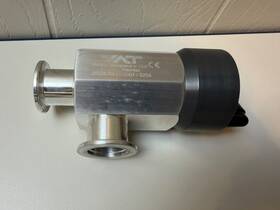
( Brand: Vat ), ( Manufacturer Part Number: 26328-KA11-0001/254 ), ( Part Type: Pneumatic Vacuum Angle Valve Aluminum ), ( Country Of Origin: Switzerland )
Review VAT 26328-ka11-0001/254 Pneumatic High Vacuum Angle Valve Aluminum
The **VAT 26328-KA11-0001/254** is a precision-engineered **pneumatic high-vacuum angle valve** designed for demanding industrial applications requiring reliable fluid control in both vacuum and low-pressure environments. Part of the **KF25/NW25** series, this valve combines robust construction with advanced pneumatic actuation to deliver seamless operation in systems where precise sealing, minimal leakage, and rapid response are critical. The **KF25** connection standard ensures compatibility with standard vacuum fittings, while the **NW25** flange interface provides a secure, leak-tight seal, making it ideal for use in semiconductor manufacturing, pharmaceutical processing, analytical instrumentation, and other high-purity environments where contamination must be strictly controlled.
Constructed from high-grade materials, including **stainless steel (AISI 304 or 316L)** for the body and **PTFE or Viton seals**, this valve is engineered to withstand extreme temperature fluctuations, aggressive chemicals, and repeated cycling without compromising performance. The **pneumatic actuator** (operating on compressed air or nitrogen) ensures quick and consistent valve actuation, reducing downtime and improving process efficiency, while the **angle design** optimizes space utilization in compact systems. With a **high-vacuum-rated construction**, this valve maintains integrity at pressures as low as **10 mbar**, making it suitable for ultra-high-vacuum (UHV) applications where even trace gas leakage could disrupt sensitive operations.
The **KA11** designation indicates a **normally closed (NC) configuration**, meaning the valve remains sealed until activated by pneumatic pressure, enhancing safety in systems where unintended fluid release must be prevented. The **0001/254** variant specifies a **single-port design** with a **25mm (1") KF connection**, ensuring compatibility with standard vacuum tubing and fittings while maintaining a compact footprint. Additional features may include **electronic position feedback** (via optional sensors) for process monitoring, **backlash-free actuation** for precise control, and **modular mounting options** for easy integration into existing systems. Whether used in **gas delivery, vacuum pumping, or process isolation**, this valve delivers uncompromising performance, durability, and reliability in environments where precision and cleanliness are non-negotiable.
### **Pros and Cons of buying a Pneumatic High Vacuum Angle Valve (VAT 26328-KA11-0001/254 26328-KA11-0001, KF25 NW25)**
#### **Pros**
1. **High Performance for Vacuum Applications**
- Designed for high-vacuum systems (ultra-high vacuum capable), ensuring minimal leakage and reliable sealing. This makes it suitable for applications requiring precise control, such as semiconductor manufacturing, research labs, or industrial vacuum processes.
2. **Pneumatic Actuation**
- The pneumatic drive system provides fast, consistent, and reliable operation without electrical interference, reducing the risk of arcing or contamination in sensitive environments. It is also easier to integrate into existing pneumatic control systems.
3. **Durable Construction**
- The valve is likely built with high-quality materials (e.g., stainless steel, CF flanges, or other corrosion-resistant alloys) to withstand harsh conditions, including exposure to chemicals, temperature fluctuations, and repeated cycling.
4. **Compatibility with KF25 and NW25 Flanges**
- The dual flange compatibility (KF25 and NW25) offers flexibility in system integration, allowing it to fit into existing setups without requiring additional adapters or modifications. This is particularly useful in research or industrial environments where multiple flange standards may be present.
5. **Precision and Repeatability**
- High-vacuum valves are engineered for precise control, ensuring consistent opening and closing cycles. This is critical in applications where repeatability and reliability are non-negotiable, such as in vacuum chambers or process control systems.
6. **Low Outgassing**
- Designed to minimize outgassing, which is essential for maintaining clean vacuum environments in sensitive applications like semiconductor fabrication or particle physics experiments.
7. **Easy Maintenance and Cleaning**
- The modular design and accessible components (e.g., replaceable seals, gaskets) simplify maintenance and cleaning, reducing downtime and extending the valve s lifespan.
8. **Compatibility with Automation Systems**
- The pneumatic drive can be easily integrated into automated control systems, making it suitable for robotic or computer-controlled processes.
---
#### **Cons**
1. **High Initial Cost**
- High-vacuum valves, especially those with pneumatic actuation and dual flange compatibility, are typically more expensive than standard valves. The cost may be prohibitive for small-scale or budget-limited applications.
2. **Specialized Installation Requirements**
- Installing a high-vacuum valve requires expertise to ensure proper alignment, sealing, and integration with the vacuum system. Improper installation can lead to leaks, reduced performance, or damage to the valve or surrounding equipment.
3. **Limited Availability of Spare Parts**
- Due to the niche nature of high-vacuum components, finding replacement parts or compatible seals may be challenging. This could lead to extended downtime if a part fails and is not readily available.
4. **Pneumatic Dependency**
- The valve relies on a pneumatic system for operation. If the air supply fails or is contaminated, the valve may not function correctly. This adds complexity to the overall system design and requires backup or redundant air supply solutions.
5. **Potential for Contamination**
- While designed to minimize outgassing, improper handling or maintenance (e.g., using contaminated lubricants or seals) can introduce contaminants into the vacuum system. This is a critical concern in cleanroom or ultra-high-vacuum applications.
6. **Size and Space Constraints**
- The valve s physical dimensions (especially with KF25/NW25 flanges) may not fit in compact or space-limited systems. Careful planning is required to ensure proper placement without compromising performance.
7. **Training and Expertise Required**
- Operating and maintaining a high-vacuum pneumatic valve may require specialized training. Staff unfamiliar with vacuum systems or pneumatic controls could inadvertently cause damage or operational issues.
8. **Potential for Leakage Over Time**
- Even high-quality valves can develop leaks over time due to wear and tear on seals or gaskets. Regular inspections and maintenance are necessary to prevent performance degradation.
---
### **Conclusion**
The **VAT 26328-KA11-0001/254 pneumatic high-vacuum angle valve (KF25 NW25)** is a specialized component ideal for applications demanding precision, reliability, and compatibility with high-vacuum environments. Its pneumatic actuation, dual flange compatibility, and low-outgassing properties make it a strong choice for industries such as semiconductor manufacturing, research, or industrial vacuum processes. However, its high cost, specialized installation requirements, and dependency on pneumatic systems may pose challenges for smaller operations or those with limited expertise.
### **Recommendation**
- **Buy if:**- You are working in a **high-vacuum application** where precision, reliability, and contamination control are critical (e.g., semiconductor fabrication, particle physics, or advanced research).
- Your system already uses **pneumatic controls** or can easily integrate them.
- You have access to **technical expertise** for installation, maintenance, and troubleshooting.
- Budget constraints are not a major concern, as the long-term benefits justify the initial investment.
- **Avoid if:**- Your application does not require **ultra-high-vacuum performance** and a standard valve would suffice.
- You lack the **budget** or **expertise** to properly install, maintain, or troubleshoot the valve.
- The valve s size or flange compatibility does not align with your system s requirements.
- Your operations are **low-volume or non-critical**, where the cost and complexity outweigh the benefits.
For most **industrial or research-grade vacuum systems**, this valve is a worthwhile investment due to its performance and durability. However, for smaller or less demanding applications, a lower-cost alternative may be more practical. Always consult with a vacuum system specialist to ensure the valve meets your specific requirements.
Details:
Removed from a working environment.
part #: 26328ka110001254 prices
- $99.98-$219.05
specifications valvplu:
- brand: Vat
- mpn: 26328-ka11-0001/254
- part type: Pneumatic Vacuum Angle Valve Aluminum
- country of origin: Switzerland
shipping valvplu:
- transit: 3-6 Days
- cost: $0.00
- carrier: FedEx
- type: Calculated
- service: FedEx Ground Economy
- class: Economy
seller valvplu:
- city: Auburn Hills, Michigan
- # reviews: 1519
- rating: 99.7%
offer valvplu:
- options: Ship-to-home
- started: March 21, 2026
- availability: In Stock
- best offers: True
- sold: 0
- quantity: 1
general valvplu:
- Pumps Pump Accessories > Vacuum Pumps > Other Vacuum Pumps
- condition: Used
returns valvplu:
- paid by: Seller
- method: Money back
- time: 30 Days
- policy: Returns Accepted
payments valvplu:
- wallet: Apple-pay
- credit card: Mastercard
- other
Vat 26328-KA11-0001-254 Is Similar To:
- 01032-ke12-0002 Vat Mini Uhv Ultra High Vacuum Gate Valve Used Working (46.9% similar) Only items pictured are included: if a part is not pictured, or mentioned above, then it included in the sale. The bureaus of us. Serial numbers or country of manufacture may vary. Flange: NW40 Ce marked made in switzerland sale details item condition: used working, 90 day warranty estimated packed ...(November 29th, 2018)
- 01032-ue41 Vat Vacuum Gate Valve Cf Conflat Flanges (30.8% similar) 75 conflate flanges looks to be in very good cosmetic condition, possibly unused. The unpacked weight of this item is 10 pounds. All offered products are sold as advertised, is and without warranty. No software, power cords, or other accessories are included unless stated above. I hooked it up to my...(October 10th, 2018)
- 01034-ke44-0004 Vat Mini Uhv Vacuum Gate Valve Used Working (43.7% similar) Vat KE44-0004 mini UV vacuum gate valve used working inventory CONG-1430 this is surplus. Pictured test equipment is not included or available for sale. Specifications part no: 01034-KE44-0004 Ce marked made in France sale details item condition: used working, 90 day warranty estimated packed ...(May 5th, 2018)
- 02010-aa44-0002 Vat Pneumatic High Vacuum (46.6% similar) Serial numbers or country of manufacture may vary. The physical condition is good, but there are signs of previous use and handling. Vat AA44-0002 pneumatic high vacuum 12 slit valve used working inventory this is surplus. Specifications part no: 02010-AA44-0002 Ce marked made in switzerland sale ...(January 8th, 2018)
- 02011-ba24-1002 Vat Vacuum Gate Valve Mono Nordiko Used Working (40% similar) Only items pictured are included: if a part is not pictured, or mentioned above, then it included in the sale. Specifications part no: 02011-BA24-1002 model series 02 mono Vat Ce marked removed from a Nordic technical services 9550 shield metal film PD sputtering system made in switzerland sale ...(June 15th, 2018)
- 0750x-ue24-ack1 Vat Rectangular Door Valve Series Amat New (26.7% similar) Vat 0750X-UE24-ACK1 rectangular door valve l-Vat series 075 Amati new inventory this is surplus. The physical condition is great. Serial numbers or country of manufacture may vary. Pictured test equipment is not included or available for sale. For lift gate service and specifications part no: 0750X-...(October 17th, 2018)
- 08134-fa44-0003 Vat Vacuum Gate Valve Dn Id (40% similar) All offered products are sold as advertised, is and without warranty. This Vat FA44-0003 vacuum mini gate valve DNA 50MM id is new and unused. The unpacked weight of this item is 6 pounds. No software, power cords, or other accessories are included unless stated above...(October 4th, 2018)
- 08234-fa44-0001-0259 Vat Vacuum Mini Gate Valve Dn (43.7% similar) This Vat FA44 vacuum mini gate valve DNA 50MM is new and unused, still sealed in its original plastic bag. The unpacked weight of this item is 4 pounds. All offered products are sold as advertised, is and without warranty. No software, power cords, or other accessories are included unless stated ...(October 17th, 2018)
- 08234-fa44-0001-0261 Vat Vacuum Mini Gate Valve Dn (45.1% similar) Approximate overall unpacked dimensions: 11 l x 6 w this Vat FA44 vacuum mini gate valve DNA 50MM is new and unused, still sealed in its original plastic bag. All offered products are sold as advertised, is and without warranty. No software, power cords, or other accessories are included unless ...(April 27th, 2018)
- 09040-pe01-0001 Vat Manual Actuator Gate Valve Used Working (35.8% similar) The bureaus of us. Only items pictured are included: if a part is not pictured, or mentioned above, then it included in the sale. Serial numbers or country of manufacture may vary. Vat PE01-0001 manual actuator gate valve used working inventory CONG-1455 this is surplus. Specifications part no: ...(May 7th, 2018)
- 09140-ue-adc1-xxxx Vat Valve Gate Doubling Acting Pneumatic Flange (27.8% similar) 1 gate valve. Doubling acting pneumatic valve with 6 cf flanges 4 id. Without solenoid, with position indicator switches and wiring harness 7 pin plug. Used but was in excellent working condition when operations shut down. Vat valve UE24-ADC1, series flange will have 16 tapped holes with inf thread ...(December 30th, 2018)