OSAKA TH162 Turbomolecular Pump Vacuum /vacuum
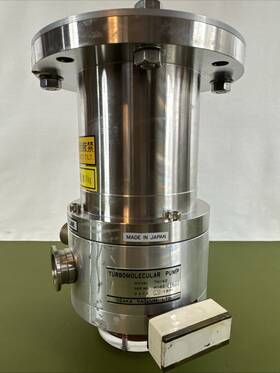
( Brand: Osaka ), ( Manufacturer Part Number: TH162 ), ( Part Type: Vacuum Pump ), ( Country Of Origin: Japan )
Review OSAKA Turbomolecular Pump /vacuum
The **Osaka TH162 Turbomolecular Pump** is a high-performance, compact yet robust vacuum solution engineered for precision applications requiring ultra-high vacuum (UHV) environments. Part of Osaka Vacuum s renowned TH series, this turbomolecular pump combines cutting-edge design with exceptional reliability, making it an ideal choice for industries such as semiconductor manufacturing, thin-film deposition, surface science research, and advanced materials processing. With a nominal pumping speed of up to **162 liters per second (L/s) for nitrogen (N )**, the TH162 delivers efficient gas handling while maintaining a clean, oil-free operation eliminating the risk of contamination that traditional rotary vane pumps often introduce. Its **three-stage turbine rotor** ensures rapid evacuation, reducing chamber pumping times and enhancing overall system productivity. The pump s **ceramic bearings** provide superior durability and resistance to thermal fluctuations, while its **high-speed permanent magnet motor** (operating at up to **36,000 RPM**) ensures consistent performance without the need for frequent maintenance. The TH162 is equipped with a **modular design**, allowing for easy integration into existing vacuum systems, and its **compact footprint** (measuring approximately **200 x 200 x 250 mm**) makes it suitable for space-constrained applications. Advanced features such as **active vibration suppression** minimize mechanical noise and ensure stable operation, while its **digital control interface** enables precise monitoring and adjustment of pumping parameters. Built to meet stringent industry standards, including **ISO 286** and **JIS B 0102**, the TH162 offers a **base pressure of 1 10 Torr (1.3 10 Pa)** when paired with an appropriate fore-pump, making it capable of sustaining the most demanding UHV requirements. Whether used in research laboratories, cleanroom environments, or industrial production lines, the Osaka TH162 turbomolecular pump exemplifies a perfect blend of performance, reliability, and innovation, ensuring optimal vacuum performance for years to come.
### **Pros and Cons of buying a Osaka TH162 Turbomolecular Pump**
#### **Pros**
1. **High Performance and Speed**
The TH162 is a robust turbomolecular pump designed for high-vacuum applications, capable of achieving ultra-high vacuum (UHV) levels when paired with a roughing pump. Its high pumping speed (162 L/s for nitrogen) ensures efficient evacuation, reducing chamber pumping times significantly compared to lower-performance pumps.
2. **Reliability and Durability**
Osaka s turbomolecular pumps are known for their sturdy construction and long operational lifespan. The TH162 features a sealed rotor design, reducing wear and tear, and its oil-free or oil-lubricated variants (depending on model) enhance reliability by minimizing contamination risks.
3. **Versatility in Applications**
This pump is suitable for a wide range of scientific and industrial applications, including:- Thin-film deposition (sputtering, evaporation)
- Surface science and materials research
- Semiconductor manufacturing
- Leak detection and residual gas analysis
Its adaptability makes it a valuable asset in research labs, cleanrooms, or production environments requiring precise vacuum control.
4. **Energy Efficiency**
Compared to older turbopumps, the TH162 incorporates energy-saving technologies, such as variable speed control, which can reduce power consumption during operation. This is particularly beneficial for long-term or continuous use.
5. **Compatibility with Ancillary Equipment**
The TH162 is designed to integrate seamlessly with other vacuum components, such as fore pumps (e.g., rotary vane or dry pumps) and vacuum chambers. Osaka provides compatible accessories, ensuring ease of installation and maintenance.
6. **Maintenance-Friendly Design**
While turbopumps generally require periodic maintenance, the TH162 s modular components (e.g., replaceable bearings, seals, and rotor assemblies) simplify servicing. Osaka also offers training and support, which can be crucial for users unfamiliar with turbopump maintenance.
7. **Global Availability and Support**
Osaka is a well-established manufacturer with a strong global presence, offering parts, service centers, and technical support in many regions. This ensures easier access to replacements and troubleshooting assistance.
---
#### **Cons**
1. **High Initial Cost**
The TH162 is a premium turbomolecular pump, and its upfront cost is significantly higher than that of basic rotary vane or diaphragm pumps. This can be a barrier for small labs, startups, or budget-conscious users.
2. **Complex Installation and Setup**
Unlike simpler vacuum pumps, turbomolecular pumps require careful installation, including proper alignment, sealing, and integration with fore pumps. Improper setup can lead to inefficiencies, damage, or even failure. Users may need specialized knowledge or professional assistance.
3. **Maintenance Requirements**
While the TH162 is durable, it still demands regular maintenance, such as:- Oil changes (if oil-lubricated)
- Seal replacements
- Bearings inspection and lubrication
- Rotor cleaning (to prevent contamination buildup)
Neglecting maintenance can reduce performance and lifespan, adding to long-term costs.
4. **Sensitivity to Contamination**
Turbomolecular pumps are vulnerable to particulate or chemical contamination, which can degrade performance or damage internal components. In environments with poor vacuum chamber cleanliness (e.g., unfiltered air leaks or outgassing materials), the pump may require more frequent cleaning or replacement of parts.
5. **Noise and Heat Generation**
The TH162, like most turbopumps, operates at relatively high speeds, producing noticeable noise and generating heat. This may require additional soundproofing or cooling measures in sensitive environments, adding to installation complexity.
6. **Dependence on Fore Pump Performance**
The efficiency of the TH162 is directly tied to its fore pump. If the fore pump (e.g., rotary vane or scroll pump) is undersized or malfunctioning, the turbopump s performance will suffer. This adds another layer of dependency and potential failure points.
7. **Limited Lifespan Compared to Some Alternatives**
While durable, turbomolecular pumps have a finite lifespan, typically ranging from 10,000 to 30,000 hours depending on usage and maintenance. In high-demand environments, this may require replacement sooner than other vacuum solutions, such as cryopumps (though these have different trade-offs).
8. **Training and Expertise Needed**
Operating and maintaining a turbopump effectively requires training. Users without prior experience may struggle with diagnostics, troubleshooting, or optimizing performance, potentially leading to downtime or inefficiencies.
---
### **Conclusion**
The Osaka TH162 turbomolecular pump is a high-performance, reliable, and versatile tool for applications requiring ultra-high vacuum. Its strengths lie in its speed, durability, and compatibility with advanced scientific and industrial processes. However, its high cost, complex installation, and maintenance demands make it less suitable for low-budget or simple applications.
For users in research labs, semiconductor manufacturing, or other fields where precision and efficiency are critical, the TH162 offers significant advantages. Conversely, smaller labs, educational institutions, or users with limited technical resources may find it overkill or prohibitively expensive.
---
### **Recommendation**
**Buy the Osaka TH162 if:**- You require ultra-high vacuum for critical applications (e.g., thin-film deposition, surface science).
- Your budget allows for a premium vacuum solution with long-term reliability.
- You have access to technical support or can invest in training for installation and maintenance.
- Your workflow demands high pumping speeds and minimal downtime.
**Consider alternatives if:**- Your application does not require UHV (e.g., basic laboratory experiments or low-vacuum processes).
- Budget constraints are a priority; lower-cost turbopumps (e.g., smaller models or used units) or hybrid systems (e.g., turbopump dry fore pump) may suffice.
- You lack in-house expertise for maintenance; opt for a simpler pump or outsource servicing.
- Your environment is prone to contamination; a cryopump or dry pump might be more robust in such conditions.
**Final Suggestion:**If the TH162 is within your budget and aligns with your needs, it is an excellent long-term investment. Pair it with a compatible fore pump (e.g., Osaka s own models for seamless integration) and establish a maintenance schedule to maximize its lifespan. For users on a tighter budget or with simpler requirements, explore used or refurbished units, or consider smaller turbopumps (e.g., TH100 series) as a cost-effective alternative.
Details:
part #: th162 price
- $889.11
specifications valvplu:
- brand: Osaka
- mpn: Th162
- part type: Vacuum Pump
- country of origin: Japan
general valvplu:
- condition: Used
- Pumps Pump Accessories > Vacuum Pumps > Turbomolecular Pumps
shipping valvplu:
- carrier: UPS
- cost: $99.95
- class: Economy
- transit: 4-8 Days
- type: Fixed
- service: UPS Ground Saver
returns valvplu:
- time: 30 Days
- method: Money back
- paid by: Buyer
- policy: Returns Accepted
payments valvplu:
- other
- wallet: Google-pay
- credit card: Diners-club
seller valvplu:
- # reviews: 11214
- city: Nampa, Idaho
- rating: 99.9%
offer valvplu:
- sold: 0
- quantity: 1
- options: Ship-to-home
- availability: In Stock
- started: March 26, 2026
Osaka TH162 Is Similar To:
- A097215-7 Osaka Tc530 Turbo Vacuum (50.7% similar) Osaka TC530 turbo vacuum pump controller. Good working condition...(November 20th, 2017)
- Tc1103 Osaka Vacuum 650va Digital (29.7% similar) width in inches: 20. Minimum handling charge is 75 onto a standard pallet and increases for custom pallet's. Osaka vacuum TC1103 650VA digital turbomolecular pump power supply unit module this offer only comes with what is pictured or listed in the. B program version: P02. Standard shipping prices...(February 16th, 2018)
- Tc76-10 Osaka Vacuum Ltd Turbo (36.6% similar) ...(August 27th, 2017)
- Td2000 Osaka D144487 Vacuum Power (35.1% similar) All offered products are sold as advertised, is and without warranty. Unfortunately I lack the knowledge and equipment to test properly so it is being sold as-is. No software, power cords, or other accessories are included unless stated above. This Osaka vacuum TD2000 power supply looks to be in ...(October 17th, 2017)
- Tg-1300 Osaka Vacuum Compound Molecular Pump (51.8% similar) High cost, value equipment, acquired from a reliable source. All statements regarding products and their configurations are made to the best of our ability with assumption that buyer is knowledgeable proficient in use this type equipment. No manuals,no standard power cords, even if it appears in the...(April 1st, 2018)
- Tg1100fbwb Osaka Vacuum Turbomolecular Pump System Hours Used Tested Working (47.9% similar) The bureaus of us. Serial numbers or country of manufacture may vary. The physical condition is good, but there are signs of previous use and handling. Pictured test equipment is not included or available for sale. Only items pictured are included: if a part is not pictured, or mentioned above, then...(July 13th, 2018)
- Tg200rwx Oshaka Vacuum Osaka Uhv (21.9% similar) It is important that you keep all damaged shipping cartons and contents. 232PRIORITY worldwide tracked packet 12'' x 6 '' 3 lbs. 232PRIORITY worldwide when you purchasing more than one item, please let me know so that the shipping may be combined. All merchandise shipped is carefully pre-checked and...(September 4th, 2017)
- Tg220f Osaka Vacuum Tg-f Series (30.6% similar) length in inches: 12. Osaka vacuum TG220F tag-f series compound turbo pump turbo molecular pump module this offer only comes with what is pictured or listed in the. Do not discard the packaging. Your satisfaction is extremely important to us. All parts, accessories, cables, etc. All parts, ...(December 30th, 2017)
- Tg220frwb Osaka Vacuum Water Cooling Compound Molecular Pump For (45.7% similar) width in inches: 12. All parts, including accessories and cables are only included if pictured or listed in the. This unit has been used. USPS or ups ground. 30-DAY DOA warranty this product carries. All parts, accessories, cables, etc. Do not discard the packaging. Standard shipping prices are ...(October 1st, 2018)
- Tg3213bw Osaka Vacuum Compound Molecular Pump (51.2% similar) Please commit to buy only after you decided purchase are ready pay. Warranty, if any, pertains to the physical operating condition of unit only. New Osaka vacuum compound molecular pump TG3213BW. No software are included with any systems. Please refer to pictures are actual of the pump. Good working...(May 2nd, 2018)
- Tg3260mbw Osaka Vacuum Compound Molecular Pump Power Supply Cable Hva (45.5% similar) Used Osaka vacuum compound molecular pump TG3260MBW with power supply TC3260, cable, hvac 1203R valves. Warranty, if any, pertains to the physical operating condition of unit only. Technical support for this item is not included in the offer. Box or APO FPO address. Good working condition. Please ...(June 3rd, 2018)