DVP 9601068 Lc Oil Rotary Vane Vacuum Pump LC.60
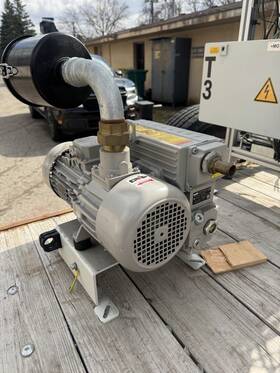
( Brand: Dvp ), ( Manufacturer Part Number: 9601068 ), ( Country Of Origin: Germany ), ( Type: Vacuum )
Review DVP Pumps Oil Lubricated Rotary Vane Vacuum Pump
The **DVP 9601068 Pumps LC.60 Oil Rotary Vane Vacuum Pump** is a high-performance, oil-sealed rotary vane vacuum pump designed for precision applications requiring reliable and consistent vacuum performance in a compact yet robust package. Engineered for industrial, laboratory, and manufacturing environments, this pump delivers exceptional suction power while maintaining low noise levels and minimal vibration, making it ideal for sensitive processes such as vacuum drying, degassing, packaging, and material testing. Its oil-rotary vane mechanism ensures smooth operation by utilizing a rotating vane system that traps and compresses gas within the chamber, gradually expelling it through a carefully designed exhaust port while maintaining an efficient seal through the lubricating properties of high-quality vacuum oil. The LC.60 model, in particular, is optimized for medium to high vacuum applications, typically achieving ultimate vacuum levels as low as **10 mbar (10 Torr)**, making it suitable for tasks requiring partial or rough vacuum conditions without the need for cryogenic or diffusion pump assistance.
Constructed with durability in mind, the DVP 9601068 features a sturdy cast iron housing that resists wear and deformation over prolonged use, while its precision-machined components including the vane, rotor, and stator are designed to operate with minimal clearance, reducing energy consumption and extending the lifespan of the pump. The integrated oil reservoir is engineered to maintain optimal lubrication levels, ensuring consistent performance and protecting critical moving parts from premature degradation. For enhanced usability, the pump is equipped with a robust motor assembly, often featuring a **three-phase induction motor** (or single-phase variants depending on configuration), which provides efficient power conversion and smooth operation. Additional features may include a built-in oil level gauge, a vacuum gauge port for real-time monitoring, and a compact footprint that allows for easy integration into existing workflows or laboratory setups.
Safety and ease of maintenance are prioritized in the design of this vacuum pump. The DVP 9601068 incorporates a **pressure relief valve** to prevent overpressurization, while its sealed construction minimizes the risk of oil leakage, reducing the need for frequent servicing. The pump s oil can be easily drained and replenished through a convenient access point, and the vanes are designed for quick replacement if wear becomes apparent, ensuring minimal downtime. For applications involving corrosive or abrasive gases, the pump may be equipped with specialized seals or materials resistant to chemical degradation, adding versatility to its operational capabilities. Whether used in semiconductor manufacturing, food processing, or scientific research, this vacuum pump offers a balance of efficiency, reliability, and adaptability, making it a dependable choice for professionals demanding high-performance vacuum solutions.
### **Pros and Cons of buying a Leybold DVP 9601068 (LC.60) Oil-Rotary Vane Vacuum Pump**
#### **Pros:**1. **High Performance and Efficiency** The LC.60 model is designed for medium to high vacuum applications, capable of achieving final pressures as low as **1 x 10 mbar (0.01 Torr)** with proper oil maintenance. This makes it suitable for processes requiring moderate vacuum levels, such as degassing, freeze-drying, or laboratory applications.
2. **Reliable and Durable Construction** Leybold is a well-established manufacturer in vacuum technology, known for robust engineering. The DVP series is built with precision-machined components, ensuring long-term reliability if properly maintained.
3. **Moderate Power Consumption** At **0.6 kW**, it is energy-efficient compared to larger industrial pumps while still delivering strong suction performance.
4. **Oil-Lubricated Design** The rotary vane mechanism is lubricated by oil, which reduces wear and extends the pump s lifespan compared to dry pumps, though it requires regular oil changes.
5. **Compatibility with Leybold Systems** If you already use other Leybold components (e.g., controllers, valves, or roughing pumps), this pump integrates seamlessly into existing setups.
6. **Decent Flow Rate (60 L/s)** The **LC.60** designation indicates a pumping speed of **60 liters per second**, which is adequate for many laboratory and small-scale industrial applications.
7. **Quiet Operation** Compared to some larger or less refined pumps, the DVP series operates relatively quietly, making it suitable for lab environments where noise is a concern.
8. **After-Sales Support and Availability of Spare Parts** Leybold has a strong global support network, and replacement parts (such as vanes, seals, and oil) are widely available.
---
#### **Cons:**1. **Oil Maintenance Requirements** Oil-lubricated pumps require **regular oil changes (every 2,000 4,000 hours of operation)** and monitoring for contamination. Neglecting this can lead to reduced performance or pump failure.
2. **Limited Final Vacuum** While it can reach **1 x 10 mbar**, it is not suitable for ultra-high vacuum (UHV) applications, which require pressures below **1 x 10 mbar**. For such needs, a different pump type (e.g., turbomolecular or diffusion pump) would be necessary.
3. **Sensitivity to Contaminants** Oil-based pumps are vulnerable to **water vapor, particulate matter, and corrosive gases**, which can degrade the oil and damage internal components. A proper **forepump or gas ballast** may be needed for certain applications.
4. **Higher Initial Cost Compared to Basic Models** While not excessively expensive, it is more costly than entry-level rotary vane pumps (e.g., some basic oil-sealed models). The price reflects Leybold s reputation and build quality.
5. **Noise and Vibration** Though quieter than some industrial pumps, it may still produce noticeable vibration and noise, which could be an issue in sensitive environments.
6. **Not Ideal for High-Gas-Load Applications** If the system frequently handles **large volumes of gas (e.g., high outgassing loads)**, the pump may struggle to maintain pressure, requiring additional measures like a **cryopump or booster pump**.
7. **Limited Lifespan Without Proper Care** Like all oil-sealed pumps, its lifespan depends heavily on maintenance. Poor oil management or exposure to contaminants can significantly reduce its operational life.
---
### **Conclusion**
The **Leybold DVP 9601068 (LC.60) oil-rotary vane vacuum pump** is a **reliable, mid-range vacuum solution** well-suited for **laboratory applications, degassing, freeze-drying, and small-scale industrial processes** where a final vacuum of ** 0.01 Torr is sufficient**. It offers **good performance, durability, and compatibility with Leybold s ecosystem**, making it a strong choice for users who prioritize **quality and support**.
However, it is **not ideal for ultra-high vacuum (UHV) applications** or environments with **high gas loads or aggressive contaminants**. Users must be prepared for **regular oil maintenance** to ensure longevity.
### **Recommendation**
- **Buy if:**- You need a **dependable, mid-range vacuum pump** for **laboratory, freeze-drying, or degassing applications**.
- You already use **Leybold components** and want seamless integration.
- You can **commit to regular oil changes and proper maintenance**.
- Your application does **not require ultra-high vacuum** (below 1 x 10 mbar).
- **Consider alternatives if:**- You need **ultra-high vacuum (UHV) or better final pressures** (e.g., turbomolecular or diffusion pumps).
- Your system has **high gas loads or corrosive gases** (may require a dry pump or additional fore-pumping).
- You prefer **low-maintenance options** (dry pumps eliminate oil changes but may have shorter lifespans).
- Budget is a concern (basic oil-sealed pumps from other brands may suffice for simpler applications).
For most **moderate vacuum needs in controlled environments**, the **Leybold DVP 9601068 is a solid investment** if maintenance is not overlooked. Always pair it with **proper filtration and a forepump** if handling contaminated gases.
Details:
part #: 9601068 price
- $1899.00
specifications valvplu:
- brand: Dvp
- mpn: 9601068
- country of origin: Germany
- type: Vacuum
returns valvplu:
- policy: No Returns
seller valvplu:
- rating: 99.0%
- city: Canton, Michigan
- # reviews: 9610
shipping valvplu:
- type: Fixed
- transit: 3-8 Days
- cost: $100.00
- service: USPS Ground Advantage
- carrier: USPS
- class: Standard
general valvplu:
- Pumps Pump Accessories > Vacuum Pumps > Other Vacuum Pumps
- condition: Used
payments valvplu:
offer valvplu:
- best offers: True
- options: Ship-to-home
- quantity: 1
- availability: In Stock
- started: March 10, 2026
- sold: 0
Dvp 9601068 Is Similar To:
- Drsfk10 Duke Vacuum Pump Exhaust Filter Kit For Busch Dvp (30.3% similar) PD01 oil plug, drainers. 029 gasket,ex box cover, drys. SG03 oil sight GLASS1 alumni gasket,oil DRSBS101 baffle strainer for Busch RA400 DRSOR13 O-RING,VITON,35 x 4MM 8 BOXEF630 box 20X10X12 - duke vacuum pumps, inc duke pumps offers servicing, replacing, and repairing in all makes model's. All ...(May 12th, 2019)
- Dvp-500 Vrc Multi-stage Rotary Vane (45.4% similar) Toner, ink cartridge, bulb, and batteries. Minimum handling charge is 75 onto a standard pallet and increases for custom pallet's. On a scale from, with 10 being in new or excellent condition, this item is rated as if you do receive the package, submit clear images of packaging box and damaged item ...(February 1st, 2018)
- Za.60s 9210006 Dvp Technology Vacuum Pump Air Cooled Firbimatic Stock (27.5% similar) Dvp vacuum pump, air cooled 230V, , stock...(November 29th, 2018)
- Dvp-03 Autogen Air Vacuum Pump Pa For Ac Refrigerant 7445006396338 (32.8% similar) Typical air vacuum pump usage include hvac refrigerant recovery, A/C repair or recharging an automobile. Wine degassing, purposes, automatic brand auto gen model VP-400 VP2S-500 VP2S-700 stages free air displacement 4 cfm 5/7 ultimate vacuum pa oz 14. 3 pa for hvac auto ac refrigerant recharging, ...(March 21st, 2021)
- Dvp 9603024 Lc305 9603024 sg Rotary Vane Vacuum Pump (64.9% similar) CW4687-2861W. Model: LC305 9603024/SG. Dvp LC305 9603024/SG rotary vane vacuum pump...(November 13th, 2024)
- Dvp 19602026 ma Pump Dc16d Oil Sealed High Vacuum (59.5% similar) Shipped with economy shipping. Dvp pump DC16D oil sealed high vacuum 1960 2026/MA. Condition is used...(March 28th, 2025)
- Dvp Db.2d 9602017 Rotary Vane Type Vacuum Pump (59.3% similar) Condition is used. Type: DB.2D 9602017. Rotary vane type, vacuum pump...(July 10th, 2025)
- Binks Dvp-510 Gemini Pump Basic Dpv-an-usa For Parts Or Repair (31.3% similar) Boinks - Gemini pump basic Dvp-an-USA / DVP-510 for parts or repair, unknown, used condition. See photos for items condition. The inlet pipe and strainer are designed for a five gallon bucket. I don't know how to test this item, so it is sold as for parts or repair...(March 18th, 2026)
- Dvp 9402032 Vacuum Technology Pump (39.6% similar) Its specific model, 9402032, ensures compatibility and efficiency for needs. With its durable construction and reliable brand reputation, this pump is ideal for maintaining vacuum systems in various applications. The Dvp vacuum technology vacuum pump 9402032 is a high-quality designed for industrial...(May 1st, 2026)