THOMAS 917-066 Vacuum Motor Diaphram Pump 115V
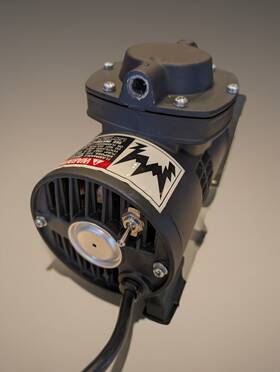
( Brand: Thomas ), ( Manufacturer Part Number: 917-066 ), ( Type: Vacuum )
Review THOMAS Vacuum Pumps Model Motor 115v Diaphram Pump
The **Thomas 917-066 Vacuum Pump** is a high-performance, diaphragm-style air pump designed for precision applications requiring reliable suction and air movement in a compact yet durable package. Engineered for versatility, this 115V AC-powered unit delivers consistent performance across a wide range of tasks, from laboratory and industrial processes to hobbyist and DIY projects. Its robust construction features a high-quality diaphragm mechanism, ensuring smooth operation with minimal wear over extended use, while its sealed motor housing protects against dust, moisture, and debris, making it ideal for both cleanroom environments and rugged workshop settings. The pump operates at a nominal voltage of 115V, providing a steady flow rate of approximately **1.5 CFM (cubic feet per minute)** at a maximum vacuum of **28 inches of mercury (Hg)**, which is sufficient for most general-purpose applications, including vacuum sealing, filtration systems, and light-duty fluid transfer. Its quiet yet efficient operation is further enhanced by a built-in pressure relief valve, which safeguards the system from overpressure conditions, while the integrated oil-free design eliminates the need for maintenance-heavy lubricants, reducing downtime and simplifying upkeep. The pump s compact yet sturdy metal housing is paired with a durable rubber diaphragm, ensuring longevity and resilience against temperature fluctuations and cyclic stress. Whether used in a laboratory for sample aspiration, in a workshop for dust collection, or in a home setting for vacuum packaging, the **Thomas 917-066** combines reliability, efficiency, and ease of use, making it a dependable choice for professionals and enthusiasts alike. Its straightforward plug-and-play design, with a standard NEMA 14-50 plug, allows for quick installation without the need for specialized tools or additional accessories, while its low-profile footprint ensures it can be easily integrated into existing setups. Overall, this vacuum pump represents a well-balanced solution for those seeking a dependable, low-maintenance air pump capable of handling a variety of demanding applications with ease.
The **Thomas 917-066** is a diaphragm vacuum pump designed for general laboratory and industrial applications, operating on 115V AC power. Below is a detailed analysis of its pros and cons, followed by a conclusion and recommendation.
---
### **Pros of the Thomas 917-066 Diaphragm Vacuum Pump**
1. **Reliability and Durability**
The Thomas Scientific brand is known for producing robust laboratory equipment. The 917-066 is designed for continuous use, making it suitable for demanding applications like filtration, degassing, or sample preparation. Its diaphragm mechanism is less prone to wear compared to rotary vane pumps, reducing maintenance needs over time.
2. **Quiet Operation**
Diaphragm pumps are generally quieter than other types of vacuum pumps (e.g., rotary vane or oil-sealed pumps), which is beneficial in laboratory settings where noise reduction is desirable.
3. **Oil-Free Design**
Since it is an oil-free pump, there is no risk of oil contamination in sensitive applications. This is particularly advantageous in pharmaceutical, chemical, or food processing environments where purity is critical.
4. **Versatility**
The pump can handle a variety of gases and vapors, including air, nitrogen, and some inert gases, making it adaptable to different laboratory tasks. It is also capable of producing moderate vacuum levels (typically up to 25 inches Hg or 85 kPa), which is sufficient for many routine applications.
5. **Low Maintenance Requirements**
Without oil or seals that require frequent replacement, the pump reduces the need for regular servicing. The diaphragm and other internal components are designed to last for extended periods with proper care.
6. **Compact and Portable**
The pump is relatively compact, making it easy to integrate into benchtop setups or portable systems. Its lightweight design also facilitates mobility if needed.
7. **Compatibility with Common Laboratory Equipment**
The pump is often used with accessories like vacuum flasks, desiccators, or filtration systems, making it a versatile addition to standard lab setups.
8. **Energy Efficiency**
Diaphragm pumps are generally more energy-efficient than larger, oil-sealed pumps for their vacuum range, though they may consume more power than some smaller, specialized pumps.
---
### **Cons of the Thomas 917-066 Diaphragm Vacuum Pump**
1. **Limited Vacuum Range**
The pump is not capable of achieving high vacuums (ultra-high or high vacuum levels). It typically maxes out around 25 inches Hg ( 85 kPa), which may be insufficient for applications requiring deeper vacuums, such as freeze-drying or certain types of spectroscopy.
2. **Slower Pumping Speed**
Compared to larger rotary vane or turbomolecular pumps, the 917-066 has a relatively slow pumping speed. This can result in longer evacuation times for larger volumes or systems with high gas loads.
3. **Potential for Diaphragm Wear**
While diaphragm pumps are durable, the diaphragm itself can degrade over time due to repeated flexing or exposure to corrosive gases. Replacement diaphragms may be required, adding to long-term costs.
4. **Sensitivity to Contaminants**
Although oil-free, the pump can be affected by particulate matter or corrosive vapors if not properly filtered. Regular cleaning or replacement of filters may be necessary to maintain performance.
5. **Higher Initial Cost**
While the pump is not excessively expensive, it may be more costly than smaller, lower-capacity diaphragm pumps or basic rotary vane pumps for very specific applications.
6. **Limited Lifespan for Heavy-Duty Use**
If subjected to continuous heavy use (e.g., 24/7 operation in industrial settings), the pump may wear out faster than expected. It is better suited for intermittent or moderate-duty applications.
7. **Noise at High Loads**
While generally quiet, the pump may produce more noise when operating under heavy loads or when evacuating large volumes quickly.
8. **Accessory Dependence**
Performance can be limited by the quality of connected tubing, valves, or filters. Poorly fitted or damaged accessories can reduce efficiency or damage the pump.
---
### **Conclusion**
The **Thomas 917-066 diaphragm vacuum pump** is a solid choice for general laboratory applications where moderate vacuum levels, oil-free operation, and reliability are priorities. It excels in settings where noise, maintenance simplicity, and versatility are important, such as routine filtration, degassing, or sample preparation. However, it is not ideal for applications requiring high vacuums, rapid evacuation, or continuous industrial use without additional safeguards.
The pump s strengths lie in its durability, quiet operation, and ease of use, making it a practical investment for many users. Its weaknesses limited vacuum range, slower pumping speed, and potential diaphragm wear are manageable for most laboratory environments but may necessitate complementary equipment (e.g., a secondary pump for deeper vacuums) in specialized applications.
---
### **Recommendation**
**Buy the Thomas 917-066 if:**- You need a reliable, oil-free vacuum pump for general laboratory use (e.g., filtration, degassing, or sample handling).
- Your applications require vacuums up to 25 inches Hg and do not demand ultra-high vacuum levels.
- Noise reduction and low maintenance are important factors in your workflow.
- You are working in environments where oil contamination is a concern (e.g., pharmaceuticals, food science, or sensitive chemical analysis).
**Consider alternatives if:**- You require deeper vacuums (e.g., for freeze-drying, spectroscopy, or high-vacuum applications). In this case, a rotary vane pump (e.g., with oil) or a turbomolecular pump may be more suitable.
- Your workflow involves frequent or continuous high-load operations, as the pump may struggle with efficiency or longevity.
- You need faster evacuation times for large volumes, as the diaphragm pump s slower speed could become a bottleneck.
- Budget constraints allow for a more specialized or higher-capacity pump that better matches your specific needs.
**Additional Tips:**- Pair the pump with appropriate filters and tubing to extend its lifespan and improve performance.
- Regularly inspect and replace diaphragms or filters as recommended by the manufacturer.
- If possible, test the pump in your specific application before committing to purchase, especially if you have unique requirements.
Overall, the **Thomas 917-066 is a well-rounded, user-friendly vacuum pump** that serves well in many standard laboratory scenarios. For niche or high-demand applications, however, a more specialized pump may be warranted.
Details:
Thomas Vacuum Pump, diaphram pumps, model: 917-066 Motor: 608104, 2.5 A, Thermally Protected, 115V 60 Hz, Used, in good condition taken from laboratory environment.
part #: 917066 price
- $150.00
specifications valvplu:
- brand: Thomas
- mpn: 917-066
- type: Vacuum
seller valvplu:
- rating: 100.0%
- city: Broomfield, Colorado
- # reviews: 110
offer valvplu:
- started: March 7, 2026
- sold: 0
- availability: In Stock
- options: Ship-to-home
- quantity: 5
- best offers: True
payments valvplu:
- wallet: Google-pay
- other
- credit card: Diners-club
general valvplu:
- Pumps Pump Accessories > Vacuum Pumps > Other Vacuum Pumps
- condition: Used
shipping valvplu:
- type: Calculated
- service: USPS Ground Advantage
- carrier: USPS
- class: Standard
- transit: 4-9 Days
- cost: $0.00
returns valvplu:
- policy: No Returns
Thomas 917-066 Is Similar To:
- 007bdc19-460g Thomas Pump Dc Vacuum Air (34.3% similar) Sold as pictured. This is in good physical condition overall minor wear and tear expected on used items. Only pictured items are included - cables and other accessories not unless explicitly stated shown in pictures. Vacuum air pump this has been tested and it is in good working order...(June 18th, 2018)
- 007bdc19h Thomas Compressor And Vacuum Air Pump Dc (40% similar) 12V dc, just removed from a suction device that was being pulled in favor of newer one. Free shipping. Working condition. Thomas compressor and vacuum air pump model 007BDC19...(April 25th, 2018)
- 007cdc19 Thomas New Diaphragm Vacuum (41.7% similar) This listing is for a brand new oem 007CDC19 pump. Hg current DRAWN3. 7 cfm 18 F10 c ambient temperature, max F40. 4 l min vacuum CONTINUOUS-23 in. Model number 007CDC19 product family type diaphragm operating mode vacuum medium gas flow rate vacuum RATE0. 8 a motor protection CLASSFSPEED2800 rpm ...(January 22nd, 2018)
- 010ca26 Thomas Air Compressor Vacuum Pump Nos (40% similar) Nos - opened box for photo. New old stock. Thomas air compressor vacuum pump, 010CA26 010CA26F nos 115V60HZ1...(April 2nd, 2018)
- 010ca26i Thomas Piston Air Pump (28.6% similar) Brand new in unopened box. These are leftovers from a project...(May 10th, 2018)
- 010cdc26-12 Thomas Hp Piston Air Pump Psi (29.7% similar) Aluminum cylinder heads and pistons. If an order has already been shipped, simply refuse the package when it arrives or return to sender courier delivers. Overall height 4 in 18. Overall width in. Not, outlet size 1/4 in. Corrosion-resistant sandwich valve stops foreign particles from lodging on...(May 7th, 2018)
- 100-0657-00 Rletschle Thomas Model Pump (34.3% similar) Let'schlep Thomas model pump U402-3...(March 16th, 2018)
- 1020569 Thomas Used Vacuum Pump Pond Motor (54.9% similar) This is a great used motor, it can be in many different applications. If you want it insured must pay for priority shipping. 6a this pump comes with motor run capacitor, black rocker toggle switch, 2 prong plug w 6' cord...(February 17th, 2019)
- 106cdc20 Thomas Vacuum Pump 12 (44.4% similar) Please refer to the pictures provided for more details on condition of item. There are a few significant scuff marks or scratches on the item. This item is in rough cosmetic condition with some wear from normal use. Quick stop offers, inc. We must sell this item as-is. We connected the pump to a 12V...(October 12th, 2017)
- 107bar20-964a Thomas Pinske Diaphragm Vacuum Pump Set Of Power Grips (40.6% similar) This item comes as pictured in good used condition. You are buying a preowned Thomas 107BAR20-964A diaphragm vacuum pump w set of pinks power grips...(December 24th, 2018)
- 107ca14-004 Thomas Compressor Vacuum Pump (37.6% similar) ...(January 14th, 2018)