LEYBOLD-HERAEUS 85419 Cryo Trap Flanges High Vacuum Jacketed LN2 KF40 Dewar Chamber Uhv
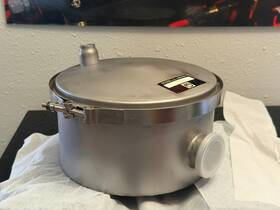
( Brand: Leybold-heraeus ), ( Manufacturer Part Number: 85419 ), ( Part Type: Vacuum Trap Flange ), ( Unit Type: Unit ), ( Chamber Material: Stainless Steel ), ( Chamber Volume: 3l ), ( Country Of Origin: United States )
Review LEYBOLD HERAEUS Ln2 Cryo Trap Flanges High vacuum jacketed Dewar Chamber Uhv
The **Leybold-Heraeus 85419 LN Cryo Trap with KF40 Flanges, High-Vacuum-Jacketed Dewar Chamber for UHV Applications** represents a precision-engineered solution for high-purity gas handling and residual gas analysis in ultra-high-vacuum (UHV) systems. Designed for demanding scientific and industrial environments, this cryogenic trap leverages advanced thermal management and cryogenic cooling to efficiently condense and trap volatile contaminants, ensuring exceptional vacuum integrity and system performance. The system incorporates a robust **high-vacuum-jacketed Dewar chamber**, which minimizes thermal conduction and radiative heat transfer, thereby optimizing the efficiency of liquid nitrogen (LN ) cooling while maintaining stable operating temperatures. The **KF40 flange connections** provide a reliable, leak-tight interface compatible with standard UHV chamber configurations, facilitating seamless integration into existing setups without compromising vacuum quality. Engineered for UHV applications, this cryo trap employs ultra-pure materials and precision machining to prevent outgassing and contamination, making it ideal for surface science research, thin-film deposition, semiconductor manufacturing, and other critical processes where residual gas control is paramount. Its modular design allows for easy installation and removal, while the durable construction ensures long-term reliability under extreme conditions. Whether used for cryopumping, gas analysis, or residual gas scavenging, the Leybold-Heraeus 85419 LN Cryo Trap delivers unmatched performance, ensuring superior vacuum levels and system stability for the most exacting applications.
### **Pros and Cons of Purchasing a Leybold-Heraeus 85419 LN Cryo Trap (KF40 Flanges, High-Vacuum-Jacketed Dewar Chamber, UHV)**
#### **Pros**
1. **High Purity and Contamination Control**
The cryogenic trap is designed for ultra-high-vacuum (UHV) applications, ensuring minimal outgassing and contamination of the vacuum system. This is critical for sensitive experiments, thin-film deposition, or surface science research where residual gases can degrade results.
2. **Efficient Gas Capture**
LN cryo traps are highly effective at condensing and trapping volatile contaminants such as hydrocarbons, water vapor, and other low-boiling-point gases. This improves vacuum quality by reducing partial pressures of these species, which can otherwise interfere with experiments.
3. **Compatibility with UHV Systems**
The KF40 flange connection ensures a leak-tight seal, which is essential for maintaining UHV conditions. The high-vacuum-jacketed dewar chamber minimizes thermal conduction and reduces the risk of frost formation on the outer surfaces, preserving the integrity of the vacuum system.
4. **Versatility in Applications**
Suitable for a wide range of UHV applications, including:- Surface science (e.g., LEED, AES, XPS)
- Thin-film deposition (e.g., sputtering, evaporation)
- Mass spectrometry
- Particle physics experiments
- Semiconductor manufacturing
5. **Long-Term Reliability**
Leybold-Heraeus is a well-established manufacturer with a reputation for durable, high-quality vacuum equipment. The cryo trap is built to withstand repeated thermal cycling and prolonged use without significant degradation.
6. **Reduced Maintenance Requirements**
Unlike mechanical pumps or ion pumps, cryo traps have fewer moving parts, reducing the likelihood of mechanical failure. Regular LN refills (typically every 8 24 hours, depending on system load) are the primary maintenance task.
7. **Cost-Effective for High-Vacuum Needs**
While the initial purchase price is significant, cryo traps can be more economical than other high-vacuum pumping solutions (e.g., cryopumps) in certain applications, especially when used in conjunction with turbopumps or ion pumps.
---
#### **Cons**
1. **High Initial Cost**
The Leybold-Heraeus 85419 is a premium piece of equipment, and the upfront investment may be prohibitive for small labs, startups, or non-industrial users. Alternative cryo traps or DIY solutions (e.g., using off-the-shelf LN dewars) may be more budget-friendly but less reliable.
2. **Dependence on LN Supply**
The trap requires a continuous or frequent supply of liquid nitrogen, which adds operational costs. LN must be stored on-site, and its consumption can be substantial, especially in high-load environments. Failure to replenish LN can lead to rapid warming of the trap and loss of vacuum performance.
3. **Limited Pumping Speed for Certain Gases**
While effective for most volatile contaminants, cryo traps are less efficient at pumping noble gases (e.g., helium, neon) or high-boiling-point compounds (e.g., some organics). Additional pumping stages (e.g., ion pumps or turbopumps) may still be required for complete vacuum performance.
4. **Thermal Management Challenges**
The high-vacuum-jacketed design helps mitigate heat transfer, but improper installation or insulation can lead to frost buildup on the outer surfaces, potentially causing condensation or ice formation that may interfere with nearby equipment. Proper placement and thermal shielding are necessary.
5. **Maintenance and Replacement Parts**
Over time, the cryo trap s internal surfaces may accumulate frozen contaminants, reducing efficiency. While not as complex as mechanical pumps, periodic cleaning or replacement of components (e.g., LN inlet valves, insulation) may be required, which can incur additional costs.
6. **Space and Logistics Requirements**
LN storage tanks and delivery logistics must be considered. Labs must allocate space for LN storage, dewars, and safety equipment (e.g., pressure relief valves, spill containment). Improper handling of LN poses safety risks, including frostbite or asphyxiation.
7. **Limited Lifespan Compared to Other Pumps**
While durable, cryo traps are not indefinitely serviceable. The effectiveness of the trap degrades over time due to surface contamination or material fatigue. Eventually, the trap may need replacement, which can be costly.
---
### **Ending Conclusion**
The Leybold-Heraeus 85419 LN cryo trap is a robust, high-performance solution for UHV applications where contamination control and gas capture are critical. Its advantages in terms of purity, efficiency, and reliability make it a valuable asset for research labs, semiconductor manufacturing, or advanced material science facilities. However, the high cost, dependency on LN , and operational complexities must be carefully weighed against the needs of the specific application.
For users with stringent UHV requirements and access to LN infrastructure, this trap is an excellent long-term investment. For smaller labs or applications where noble gases or high-boiling-point contaminants are a primary concern, complementary pumping solutions (e.g., ion pumps or cryopumps) may be necessary. Alternatively, users with lower budgets might consider refurbished units or alternative manufacturers, though this may compromise performance or reliability.
### **Recommendation**
**Purchase the Leybold-Heraeus 85419 LN cryo trap if:**- Your application demands UHV conditions with minimal contamination.
- You have access to reliable LN supply and storage.
- Budget constraints allow for the initial investment and operational costs.
- The trap will be used in conjunction with other pumping systems (e.g., turbopumps) for optimal performance.
**Consider alternatives or additional research if:**- Your budget is limited, and you can explore refurbished or lower-cost cryo traps.
- Noble gases or high-boiling-point contaminants are a significant concern, requiring supplementary pumping.
- Your lab lacks LN infrastructure, making cryogenic cooling impractical.
- You are unsure about long-term maintenance or operational logistics.
For most high-end UHV applications, the Leybold-Heraeus 85419 remains a superior choice due to its proven track record and compatibility with advanced vacuum systems. Proper planning for LN logistics and system integration will ensure optimal performance and longevity.
Details:
This design is critical for achieving deep vacuums down to 10-8 MBA by effectively freezing out water vapor and preventing oil back streaming. Space Simulation: Small-to-medium thermal vacuum chambers Vacs. Unlike standard single-walled traps, this premium unit features a vacuum-jacketed Dewar-style reservoir, providing superior thermal insulation for liquid nitrogen LN2 use. Pumping Speed: This trap is designed to handle medium high pumping speeds.
Vacuum Distillation/Freeze Drying: Where high volumes of water vapor or solvents need to be captured rapidly. Minor blemishes commensurate with age, KF40 flanges have hard to see micro-scratches but these do not impact vacuum integrity. Roots Blower Systems: It can be used on the fore line of smaller blower stacks to protect primary pump from harsh . Refurbished and fully functional.
Typical Industrial Applications Semiconductor Manufacturing: To trap process gases or pump oil vapors. A rare pre-owned stainless steel UVH Leybold-Heraeus 85419 Liquid Nitrogen LN2 Cryo Trap with 2 KF40 Flanges and acts as a Vacuum-Jacketed Dewar/chamber.
part #: 85419 prices
- $595.00-$1492.00
specifications valvplu:
- brand: Leybold-heraeus
- mpn: 85419
- part type: Vacuum Trap Flange
- unit type: Unit
- chamber material: Stainless Steel
- chamber volume: 3l
- country of origin: United States
seller valvplu:
- rating: 100.0%
- city: Houston, Texas
- # reviews: 787
returns valvplu:
- policy: No Returns
general valvplu:
- Pumps Pump Accessories > Vacuum Pumps > Vacuum Chambers
- condition: Used
payments valvplu:
- other
- credit card: Visa
- wallet: Apple-pay
offer valvplu:
- sold: 0
- started: April 6, 2026
- quantity: 1
- availability: In Stock
- options: Ship-to-home
- best offers: True
shipping valvplu:
- type: Calculated
- carrier: FedEx
- cost: $26.48
- service: FedEx Ground / FedEx Home Delivery, FedEx 2Day
- class: Standard, Expedited
- transit: 4-10 Days
Leybold-heraeus 85419 Is Similar To:
- 100b Leybold Dryvac Dry Vacuum Pump (29.5% similar) Leybold dry vac 100B dry vacuum pump...(August 25th, 2018)
- 140000 Leybold Vacuum Trivac D (29.1% similar) We encourage you to review the manufacturers specifications determine compatibility with your devices, accessories, equipment, or operating systems. Residence or business. Inside required. If above ground floor, is elevator available. This pump is used it was removed from a working system and comes ...(December 20th, 2017)
- 140002 E2 Leybold Oerlikon Vacuum Trivac With Motor (30.4% similar) Unit is being sold as and exactly pictured. We simply performed a power on test and confirmed that the knobs were functioning properly. Buyer may arrange their own shipping or a quote. If listing states unit only then it does not come with any accessories. Listing is for the item described above ...(June 28th, 2018)
- 150csv Leybold Turbovac Vacuum Module (29% similar) ...(July 13th, 2018)
- 157 51-d Leybold Penningvac Penning Vacuum Gauge Sensor Head Module Pr (29.3% similar) Save packaging for carrier claim. USPS or ups ground. Cash is only accepted for will-calls in-person. All parts, accessories, cables, etc. If you do receive the package, submit clear images of packaging box and damaged item from multiple angles. penning vacuum gauge sensor head module pr 35 this ...(April 5th, 2018)
- 15768-0 Leybold New Lh Model Vacuum Output Vdc Range Torr (26.4% similar) ...(January 5th, 2019)
- 16039 Leybold Heraeus Kat.kr Fabr (36.7% similar) This item has been fully tested by our tech department and is in good working condition...(November 28th, 2017)
- 16202br1 Leybold Heraeus Vacuum Gauge (35.5% similar) Reach out to us. No means to test. No manuals, standard power cords, even if it appears in the photo, accessories, software etc are not included unless pictured and noted...(October 8th, 2017)
- 16202br2 Leybold Heraeus Vacuum Gauge (35.5% similar) No manuals, standard power cords, even if it appears in the photo, accessories, software etc are not included unless pictured and noted. All statements regarding products and their configurations are made to the best of our ability with assumption that buyer is knowledgeable proficient in use this ...(September 8th, 2017)
- 16202v1 Leybold Heraeus Vacuum Gauge (35.8% similar) All statements regarding products and their configurations are made to the best of our ability with assumption that buyer is knowledgeable proficient in use this type equipment. No means to test fully. Has some cosmetic wear. Most cords pictured are for testing purposes only. No manuals, standard ...(October 8th, 2017)
- 1628 Leybold Heraeus Cold Cathode (36.7% similar) Send your questions before purchasing. The nominal. This listing is for one 1 leybold heraeus vacuum gauge system part labeled as follows: high voltage symbol and difficult to read the numbers Kate NR. It incorporates a magnetic element. Of the vacuum flange is 55MM. Condition: used, excellent. ...(September 19th, 2017)