CTI 8033299 Cryopump Cryo Torr
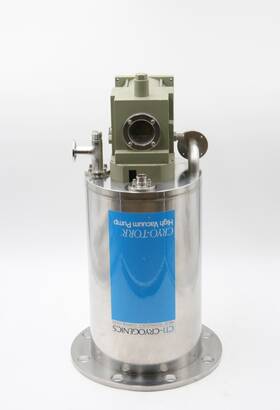
( Brand: Cti ), ( Manufacturer Part Number: 8033299 ), ( Type: Vacuum ), ( Unit Type: Unit ), ( Country Of Origin: United States )
Review CTI Cryopump Cryo torr Removed From Working Nice Condition
The **CTI Cryogenics Model 8033299 Cryo-Torr** is a high-performance, closed-cycle cryogenic pump designed for ultra-high vacuum (UHV) and scientific research applications where exceptional pumping speed, reliability, and efficiency are paramount. Engineered with precision, this cryopump leverages advanced cryogenic technology to achieve superior vacuum performance by condensing and adsorbing gases onto a cold surface, effectively reducing system pressure to levels as low as **10 Torr** in properly configured setups. The 8033299 features a robust **Gifford-McMahon (GM) cryocooler**, a closed-cycle refrigeration system that eliminates the need for liquid cryogens, ensuring continuous operation with minimal maintenance. This design not only enhances operational convenience but also reduces downtime, making it ideal for long-term experiments, semiconductor manufacturing, surface science, or particle accelerator environments where consistent vacuum integrity is critical.
The cryopump s **multi-stage cold head** operates at temperatures as low as **-269 C (-452 F)**, enabling it to efficiently adsorb a wide range of gases, including hydrogen, helium, nitrogen, and water vapor, while maintaining high pumping speeds across a broad pressure range. Its **non-evaporable getter (NEG) coating** further enhances performance by chemically adsorbing reactive gases, extending the pump s operational lifespan and improving residual gas composition. The compact yet durable construction incorporates **stainless steel housing** and **aluminum cold fingers**, ensuring thermal stability and resistance to thermal cycling, which is essential for maintaining vacuum integrity over prolonged use. The 8033299 is also equipped with **vibration-dampening mounts** and a **low-noise drive system**, minimizing mechanical disturbances that could affect sensitive instrumentation or delicate experimental setups.
For ease of integration, the Cryo-Torr is designed with **standard flange compatibility**, including options for **CF (Conflat) or ISO-KF connections**, allowing seamless incorporation into existing vacuum systems. Its **modular design** accommodates various cold head configurations, including **single-stage or two-stage cooling**, depending on the specific vacuum requirements of the application. Additionally, the pump includes **built-in safety features**, such as **over-temperature protection, pressure monitoring, and automatic shutdown protocols**, ensuring reliable operation even in demanding environments. The 8033299 is backed by CTI Cryogenics reputation for innovation and engineering excellence, offering users a dependable solution for achieving and maintaining the highest vacuum standards in research, industry, and advanced manufacturing. Whether used in surface analysis, thin-film deposition, or particle physics, this cryopump delivers unmatched performance, efficiency, and longevity.
### **Pros and Cons of buying a CTI Cryopump (Model 8033299 Cryo-Torr)**
#### **Pros**
1. **High Vacuum Performance** The CTI Cryopump is designed for achieving ultra-high vacuum (UHV) levels, making it ideal for applications requiring low-pressure environments such as semiconductor manufacturing, research labs, and thin-film deposition. Its cryogenic cooling effectively sorbs gases, including hydrogen, helium, and water vapor, which conventional pumps struggle with.
2. **Fast Pumping Speed** The cryopump offers rapid gas removal, significantly reducing chamber pump-down times compared to traditional mechanical or turbomolecular pumps. This is particularly beneficial in high-throughput processes where efficiency is critical.
3. **Long Lifespan and Low Maintenance** Unlike mechanical pumps that require frequent oil changes or part replacements, cryopumps have no moving parts (except for the compressor) and rely on cryogenic cooling. This reduces wear and tear, leading to lower long-term maintenance costs.
4. **Compatibility with Reactive Gases** The cryopump can handle reactive gases (e.g., oxygen, nitrogen) without contamination issues that plague oil-sealed pumps. This makes it suitable for processes involving corrosive or chemically reactive environments.
5. **Compact and Modular Design** The unit is relatively compact compared to some turbomolecular pumps, making it easier to integrate into existing systems. Some models also offer modular configurations for flexibility in setup.
6. **Energy Efficiency** While the compressor consumes power, the overall energy efficiency can be better than turbomolecular pumps in certain applications, especially when pumping large volumes of gas over extended periods.
7. **Versatility in Applications** Beyond UHV, cryopumps are used in:- **Semiconductor fabrication** (etching, deposition)
- **Optical coating** (thin-film deposition)
- **Medical and pharmaceutical** (vacuum sterilization)
- **Scientific research** (surface science, particle accelerators)
8. **Minimal Contamination Risk** Since the pump does not use oil or seals that degrade over time, it reduces the risk of particulate or chemical contamination in sensitive processes.
---
#### **Cons**
1. **High Initial Cost** Cryopumps are significantly more expensive upfront than mechanical or diaphragm pumps. The CTI 8033299, in particular, is a high-end model, making it a substantial investment for smaller labs or startups.
2. **Dependence on Cryogenic Cooling** The pump requires a continuous supply of liquid nitrogen (or sometimes helium) to maintain cryogenic temperatures. This adds operational costs and logistical challenges, such as storage and refilling.
3. **Limited Pumping Speed for Certain Gases** While excellent for most gases, cryopumps are less effective at pumping noble gases (e.g., argon, neon) unless combined with a backing pump. This may require additional equipment, increasing complexity.
4. **Slow Warm-Up Time** If the pump needs to be regenerated (warmed up to release trapped gases), it can take several hours, during which the system is non-operational. This downtime must be factored into production schedules.
5. **Sensitivity to Backing Pump Performance** Cryopumps require a robust backing pump (often a roughing pump) to maintain optimal performance. Poor backing pump performance can degrade vacuum levels and reduce efficiency.
6. **Potential for Ice Buildup** If not properly maintained, moisture in the system can condense on cold surfaces, leading to ice formation. This requires regular cleaning and maintenance to prevent blockages.
7. **Limited Lifespan of Compressor** The compressor (if included) is a mechanical component and may require eventual replacement, adding to long-term costs. However, this is less frequent than issues with oil-sealed pumps.
8. **Not Ideal for High-Pressure Applications** Cryopumps are designed for low-pressure environments (UHV to rough vacuum). They are not suitable for roughing or high-pressure pumping tasks, which require separate pumps.
9. **Training and Expertise Required** Operating and maintaining a cryopump effectively requires specialized knowledge, especially in managing cryogenic systems and troubleshooting vacuum leaks or pump failures.
10. **Environmental Considerations** Liquid nitrogen consumption contributes to operational costs and may require proper handling to avoid spills or waste disposal issues.
---
### **Conclusion**
The **CTI Cryopump (8033299 Cryo-Torr)** is a powerful and reliable tool for achieving ultra-high vacuum in applications where purity, speed, and low maintenance are critical. Its advantages in terms of gas sorption efficiency, longevity, and compatibility with reactive gases make it a top choice for industries like semiconductor manufacturing, research, and thin-film deposition. However, the high upfront cost, dependency on liquid nitrogen, and operational complexities (such as warm-up times and backing pump requirements) must be carefully considered.
For **large-scale industrial or research facilities** with the budget and infrastructure to support cryogenic systems, this pump is an excellent investment. For **smaller labs, startups, or applications where cost efficiency is a priority**, a cryopump may not be the most practical choice, and alternatives like turbomolecular or diaphragm pumps might be more suitable.
---
### **Recommendation**
- **Buy the CTI Cryopump (8033299) if:**- You require **ultra-high vacuum (UHV) or clean vacuum environments** with minimal contamination risk.
- Your application involves **reactive or corrosive gases** that would degrade oil-sealed pumps.
- You have **consistent access to liquid nitrogen** and can justify the **high initial cost** with long-term efficiency gains.
- Your system **benefits from fast pump-down times** and reduced maintenance overhead.
- **Consider alternatives (e.g., turbomolecular or diaphragm pumps) if:**- Your budget is **limited**, and you can achieve acceptable vacuum levels with lower-cost pumps.
- Your application does **not require UHV** and can tolerate slight contamination or slower pumping speeds.
- You lack **expertise in cryogenic systems** or infrastructure to support liquid nitrogen storage.
- Your process involves **high-pressure or rough vacuum** stages that a cryopump cannot handle alone.
For most **high-end research or production environments** where vacuum integrity is non-negotiable, the **CTI 8033299 Cryo-Torr remains a strong recommendation**. However, a thorough cost-benefit analysis including operational expenses, maintenance, and system compatibility is essential before making a purchase. Consulting with vacuum system specialists or suppliers can also help tailor the decision to your specific needs.
Details:
Gas Pumping Speeds: Water Vapor: 4,000 l/s. Specs: Configuration: Straight. Cryopump capture molecules onto cryogenic ally cooled surfaces, removing them from the process environment. Cryopump are ideal for processes requiring fast pumping of inert, non-toxic, or non-corrosive gases.
Air: 1,500 l/s. CTI Cryogenics Cryo-Torr 8 High Vacuum Pump Part #8033299, Used, removed from working service. Feel free to message with any questions. Unit is in good condition and was pulled from an operational system.
Vacuum Flange: 11 OD, 200mm ID.
part #: 8033299 price
- $2495.00
specifications valvplu:
- brand: Cti
- mpn: 8033299
- type: Vacuum
- unit type: Unit
- country of origin: United States
returns valvplu:
- method: Money back
- time: 30 Days
- policy: Returns Accepted
- paid by: Seller
payments valvplu:
- other
- credit card: Mastercard
- wallet: Google-pay
shipping valvplu:
- cost: $0.00
- type: Fixed
- carrier: FedEx
- transit: 4-10 Days
- class: Standard
- service: FedEx Ground / FedEx Home Delivery
seller valvplu:
- rating: 100.0%
- city: Saint Paul, Minnesota
- # reviews: 68
general valvplu:
- condition: Used
- Pumps Pump Accessories > Vacuum Pumps > Other Vacuum Pumps
offer valvplu:
- started: May 26, 2026
- quantity: 1
- availability: In Stock
- best offers: True
- options: Ship-to-home
- sold: 0
Cti 8033299 Is Similar To:
- 250f Cti Cryogenics Onboard Cryo Pump Vacuum Cryogenic Rebuilt (30.3% similar) It is ready to work. This Cti cryogenics 250F vacuum pump is used, rebuilt, and tested...(September 21st, 2018)
- 8018182 Cti Cryo-torr 10 Vacuum Pump W (33.3% similar) A forklift is onsite to load suitable vehicle. Weather and had some rain on it. Some controls have been removed but comes with everything shown. Cryo-torr Cti high vacuum pump model , removed from working environment but sat outside so. Items over 150 lbs. Char auto-tech ii control, 818 cryopump ...(February 25th, 2018)
- 8031346g002 Helix Water Cooled Cryo Compressor Cti Cryogenics (30.5% similar) 8MAX input power Cti-cryogenics helix 8500 water cooled cryo compressor refurbished unit, 60 day return warranty. Us domestic only. 75 karate fl Lr current a flat rate shipping vac 60HZ 50HZNOM power factor...(August 27th, 2018)
- 8033168 Cti-cryogenics Cti Cryo-torr 8 (38.9% similar) The drive motor sounds good, and there appear to be no issues with scotch-yoke assembly. The pump cools down in about roughing valve, purge gas solenoid, and heater are not included. We ran this for weeks at a time. For sale is a Cti-cryogenics cryo torr 8 pn high vacuum pump. There were no ...(September 4th, 2017)
- 8033168r Cti-cryogenics Cti Cryogenics Cryo (24.8% similar) ...(January 17th, 2018)
- 8103055g001 Cti Ct-100 Cryo Pump (25.5% similar) Pump is fully cleaned, refurbished, and ready to run. The pump was refurbished by Cti. 4 all equipment is sold as-is. Most items were purchased at inventory reduction, government surplus, or semi-conductor equipment sales. It is in like new condition. Model 8103055G001. Has a diode temperature ...(January 5th, 2018)
- 8107809g2 Cti-cryogenics Helix Cryopump Cryo-torr (38.7% similar) A pelleting fee may apply see offer. Excellent physical condition. I have been on for 18 years 14 under the same name removed from a working environment. P/N: 8107-809G2. I am a one woman show. I inspect, purchase, photograph, describe and answer all questions as well ship items personally. I buy on...(November 4th, 2017)
- 8112463g060 Cti-cryogenics On-board Cryopump Power (28.3% similar) Shipping buyer pays for all shipping costs. Cti-cryogenics 8112463G060 on-board cryopump power cable questions. Here : this lot is for one Cti cryogenics cable. This unit will arrive in the condition shown. Always here to help. Warranty this item is guaranteed to be as described. Power cords and ...(February 6th, 2018)
- 8112463g100 Cti Cryogenics Cryopump Cable (28.8% similar) Cti cryogenics 8112463G100 on-board cryopump cable the item is used but in good condition. See pictures for details...(October 6th, 2018)
- 8116266g001r Cti-cryogenics On-board 10f Cryopump (23.5% similar) Specifications li part no: 8116266G001R model on-board 10F cryopump module: 8113100G001R run time: 5039 hours installed components roughing valve 8115086G001 purge 8112661G002 sale details condition: tested working, 90 day warranty estimated packed shipping dimensions: l x W36 X24 X14 lbs. Pictured ...(February 22nd, 2018)
- Cryo-torr 7 Helix Cti Cryogenics (37.3% similar) ...(September 3rd, 2017)